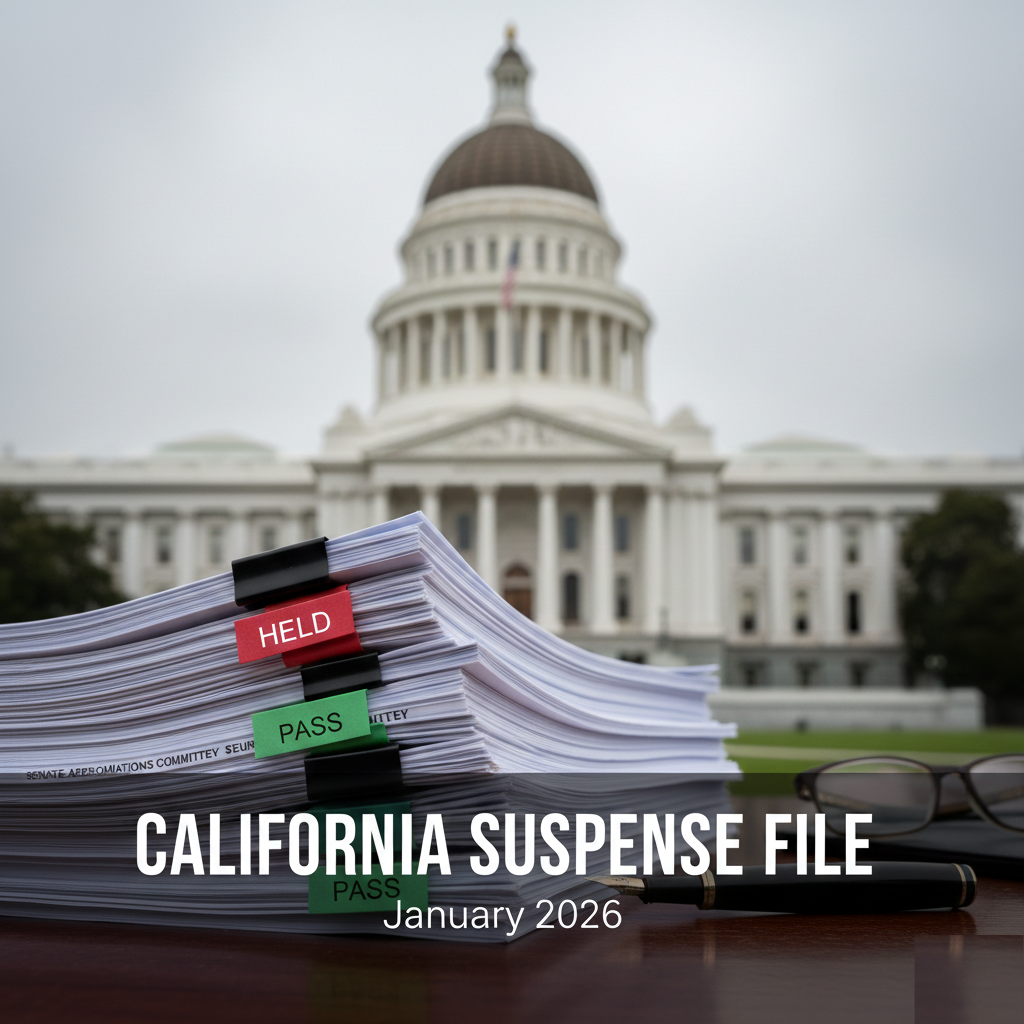
The California Suspense File January 2026 hearing is tomorrow, January 22. In under 20 minutes, the Senate Appropriations Committee will announce which bills advance and which die, all without public testimony.
Here’s the critical context: Only ten days remain. The constitutional deadline is January 31, and bills that don’t pass their house of origin by then are dead for the session. Below is where we currently stand:
| Bill | Current Status | Tomorrow’s Hearing |
| SB 300 | ✅ Cleared (Rule 28.8) | None – already advancing to Floor |
| SB 574 | 🟡 On Suspense | Suspense Hearing -fiscal verdict |
| SB 813 | 🔶 Regular Agenda | Policy hearing, not yet at fiscal stage |
The Week Ahead: Your Roadmap
| Date | Milestone | What It Means |
| Wed, Jan 21 | Today | Final lobbying window before tomorrow’s hearings |
| Thu, Jan 22 | Suspense Hearing + Regular Agenda | SB 574 verdict. SB 813 policy hearing. |
| Fri, Jan 23 | Committee Reporting Deadline | All fiscal committee bills must be reported |
| Jan 24–30 | Floor Vote Sprint | Survivors need 21 votes |
| Fri, Jan 31 | Constitutional Deadline | Pass or die |
The Fiscal Context
Ultimately, the budget math drives everything.
- LAO projection: $18 billion deficit for FY 2026-27
- Governor’s estimate: $2.9 billion (assumes favorable revenue)
We lean toward the LAO’s caution. As a result, in an $18 billion hole, new agencies get cut first. Meanwhile, even low-cost bills get held for optics. In short, the Suspense File becomes a fiscal filter, not a policy debate.
SB 300 (Padilla): Companion Chatbot Protections
Status: ✅ Cleared
What happened: On January 20, the committee applied Senate Rule 28.8 — “negligible fiscal impact.” As a result, the bill bypasses tomorrow’s Suspense hearing entirely.
Where it stands now: Advancing to second reading. Will be calendared for Floor vote.
The Inside Read:
Rule 28.8 is essentially the fast lane. By securing this designation, Senator Padilla avoided the fiscal guillotine altogether. Notably, this was strategic, he introduced SB 300 in response to OpenAI’s ballot initiative that would require a two-thirds vote for future chatbot regulations. Therefore, the faster SB 300 moves, the more protections are locked in before that initiative potentially qualifies.
Next step: Secure Floor votes by January 31.
SB 574 (Umberg): AI Attorney Accountability
Status: 🟡 On Suspense
What happened: Following its January 20 hearing, SB 574 was placed on the Suspense File. Consequently, it faces tomorrow’s Suspense Hearing.
The policy: Requires attorneys to verify AI-generated citations before filing. Additionally, it establishes professional responsibility for AI-assisted legal content. Specifically, the bill responds to documented incidents of fabricated citations in federal courts.
Fiscal profile: Minimal. Uses existing State Bar enforcement infrastructure.
Opposition: California Chamber of Commerce, UC system.
The Inside Read:
On paper, this should be an easy pass. The cost is negligible, and the policy addresses a real problem. However, in an $18 billion deficit year, “should” doesn’t guarantee anything. Leadership sometimes holds low-cost bills simply to demonstrate fiscal discipline. In other words, the savings are symbolic, the signal matters more than the dollars.
SB 813 (McNerney): AI Standards & Safety Commission
Status: 🔶 Regular Agenda
What’s different: Unlike SB 574, SB 813 is set for the January 22 Regular Agenda hearing. This is a policy hearing with testimony and debate. Importantly, it is not on the Suspense File yet.
The policy: Creates the California AI Standards and Safety Commission. Furthermore, it establishes independent verification organizations (IVOs) to audit frontier AI systems. Essentially, this is the enforcement mechanism for last year’s SB 53 transparency requirements.
Fiscal profile: Significant. New commissions require staffing, facilities, and ongoing appropriations.
The Inside Read: This is the “Main Event” of the week. Because it’s on the Regular Agenda, we get to see the public debate tomorrow. If leadership allows it to move to the Floor instead of parking it on Suspense, it signals that AI safety is the top priority for 2026, regardless of the deficit.
The Fiscal Reality: New state agencies are expensive. However, author Jerry McNerney is a veteran legislator who has amended the bill specifically to address these concerns.
Understanding the Two Tracks
It’s important to note that tomorrow’s hearings operate under different rules:
| Track | What Happens | Testimony? | Bills |
| Suspense File | Fiscal verdict only. Pass or held. | No | SB 574 |
| Regular Agenda | Policy debate. If approved, moves to Suspense. | Yes | SB 813 |
| Rule 28.8 | “Negligible cost” – bypasses Suspense entirely | N/A | SB 300 |
Here’s how the Suspense process works: The chair reads bill numbers. “Do pass” means it advances. “Held in committee” means it’s dead. Silence means held. In total, the whole list takes under 20 minutes. There’s no debate and no amendments, decisions were made in private negotiations this week.
What You Should Do Today
If you’re tracking SB 300:
At this point, shift focus to Floor strategy. The fiscal fight is over. Now it’s time to count your 21.
If you’re tracking SB 574:
Today is the last window for outreach. Remember, tomorrow is an announcement only. The decision is being finalized now.
If you’re tracking SB 813:
First, prepare testimony for tomorrow’s Regular Agenda hearing. But also prepare for both outcomes: if it clears, you still face Suspense; if it’s held, you’ll need a backup vehicle ready.
Stop Digging. Start Asking.
Tomorrow’s hearing will move fast. And when the dust settles, you’ll have questions:
- “What happened to SB 574?”
- “Did SB 813 make it out of committee?”
- “What’s the new deadline?”
- “Are there similar bills I should pivot to?”
Typically, most trackers send you a notification. Then you dig.
GovBuddy Approach is different. Instead, you simply ask it anything and get answers.
For example, our Likelihood of Passing predictions (95% accuracy*) already flagged SB 813 as high-risk weeks ago. Similarly, our Similar Bills detection surfaces related legislation you might not know exists, backup vehicles, companion bills, threats from other committees.
In short, this is bill tracking rebuilt for professionals who need to move fast.
*Accuracy applies to bills in final form. Forecasts update as bills move through the legislature.
GovBuddy Approach: Bill tracking that answers back.