


AI Isn’t Replacing Lobbyists. It’s Giving Them Their Mornings Back.
There’s a version of this story that gets told a lot. AI in government relations is coming for the lobbyists. Relationships won’t matter anymore. Just feed a bill into an algorithm and let it do the rest.
It’s a dramatic narrative. It just isn’t what’s happening.
The real story is quieter, and, frankly, more interesting. It’s about a government affairs VP at Monument Advocacy describing AI as unleashing “10 years of efficiencies overnight..” It’s about tasks that used to quietly consume two to three hours of a senior staffer’s morning now getting done in 45 seconds. Meanwhile, teams are spending less time buried in legislative databases, and more time actually talking to lawmakers.
That’s what AI in government relations looks like right now.
Not a replacement. An amplifier.
But to understand why it matters, you first have to understand the specific problem it’s solving: policy blind spots.
The Blind Spot Problem Is Real, And It’s Growing
If you’ve worked in government affairs, you know the feeling.
You open your inbox to 120 new bill alerts. Three states dropped amendments overnight. A committee markup moved up without much notice. Meanwhile, a rulemaking comment window quietly closed while you were in back-to-back meetings.
Congress alone introduces thousands of bills per session. Multiply that across 50 state legislatures. Then layer in agency rulemakings, committee markups, local ordinances, and regulatory guidance.
Even the strongest teams, disciplined, experienced, well-staffed, cannot manually track all of that without something slipping through.
The Numbers Tell You How Fast It’s Accelerating
And the pace isn’t slowing.
In 2024, U.S. federal agencies introduced a record number of AI-related regulations, more than double the year before. At the state level, 238 technology-related bills passed across 46 states, a 163% jump year over year. As a result, states are now moving faster than the federal government on everything from data privacy to AI governance.
For a GR team, that’s not just a volume problem. It’s a timing problem.
Catching a bill at committee markup is very different from catching it at introduction. Discovering an amendment the morning of a floor vote means you’re already reacting instead of shaping.
Blind spots don’t just mean missed bills. Ultimately, they mean missed opportunities to influence policy before it hardens.
Where AI Actually Shows Up in Real GR Work
Let’s get practical.
1. Scanning and Filtering at Scale
The old workflow is familiar: open feeds, run keyword searches, click into bills, skim enough text to decide whether it matters, and then repeat across jurisdictions. Do that across 15 states and Congress, and most of your morning disappears.
AI-powered platforms like Quorum, FiscalNote, and Bloomberg Government now use natural language processing to surface relevant bills automatically. Type “Show me all chemical safety bills introduced in 2024,” and you get a curated list in seconds.
The real value, however, isn’t just speed. It’s consistency. Humans miss things, especially when a bill’s title sounds unrelated or the language is indirect. AI doesn’t get tired at 9:17 a.m. It doesn’t skim when it’s distracted. It scans everything.
Where humans still decide: Which flagged bills actually matter to your strategy. AI shows you the terrain. You decide where to move.
2. Bill Comparisons and Summaries
Anyone can read a 200-page bill. The harder task is comparing five versions of similar legislation across different states, and spotting the differences that actually matter.
Historically, that meant junior staff annotating documents line by line or outside counsel billing by the hour. It worked, but it was slow and expensive.
AI in government relations changes that equation significantly.
Andrew Howell of Monument Advocacy noted that AI tools are especially useful when analyzing similar bills, identifying key differences, similarities, and even patterns in co-sponsorship. That last piece is more powerful than it sounds. Seeing which legislators consistently sponsor bills together reveals informal coalitions you won’t find on an org chart.
Where humans still decide: Legal implications and strategic impact. A summary is a starting point, not advice.
3. Stakeholder Mapping
In government affairs, the “who” matters just as much as the “what.” Who supports it? Who quietly opposes it? Who might move with the right argument?
AI tools can now scan floor statements, press releases, committee testimony, and social posts to identify where lawmakers stand, and how they talk about an issue. Ask, for example: “Which Republican lawmakers have expressed concern about federal preemption of state privacy laws?” Within seconds, you have a mapped starting point, before a single meeting is scheduled.
That changes preparation.
Where humans still decide: Who to actually call. Who’s privately skeptical. Who just lost their chief of staff. That kind of intelligence still lives in conversations, not databases.
4. Tracking Legislative Momentum
Some bills are messaging vehicles. Others are quietly building toward passage. Distinguishing between the two is critical, and surprisingly easy to get wrong when you’re monitoring dozens of issues at once.
AI tracks momentum signals: co-sponsor growth, hearing activity, floor statement volume, and historical patterns of similar legislation. If a bill stalled for three sessions and suddenly has 40 co-sponsors and a markup scheduled, that’s not noise. It’s a signal worth acting on.
Recognizing that pattern across years of data is difficult to do manually. AI in government relations makes it visible fast enough to be actionable.
Where humans still decide: Whether to push now, or wait. Momentum isn’t destiny. Politics is always contextual.
5. Briefing and Executive Prioritization
Your scarcest resource isn’t data. It’s executive attention.
AI can draft legislative memos, talking points, and impact briefs quickly. One particularly useful application is generating customized district-level impact summaries for specific lawmakers, what used to be a research project becomes structured drafting in minutes.
A study from the Brookings Institution found that members of Congress reportedly couldn’t distinguish between AI-generated and human-written constituent communications. That’s not a replacement story. It’s a productivity story.
Where humans still decide: What to escalate, when to escalate, and why it matters strategically. Those calls still belong to people.
The Patterns Humans Miss
Policy has memory.
A bill that fails often returns with amended language. An issue that gains traction in California tends to spread to other states within 18 to 24 months. Agencies frequently telegraph enforcement priorities through guidance documents before final rules ever appear.
AI can surface these patterns across years of data, not just this session. That means institutional memory that doesn’t disappear when a senior staffer leaves.
It doesn’t replace political judgment. Instead, it strengthens it by giving professionals a longer view of how issues actually move.
Where AI Doesn’t Belong (Yet)
It’s important to be clear about the limits.
Relationship intelligence? Still human.
Political instinct? Still human.
High-stakes strategic judgment under uncertainty? Absolutely still human.
Joseph Hoefer of Monument Advocacy raised an important point: AI systems inherit bias from the data they’re trained on. If teams aren’t careful, those biases quietly seep into analysis without anyone noticing.
AI in government relations is powerful, but it is not politically aware. Treating it as such is where teams get into trouble.
What Good AI-Augmented GR Actually Looks Like
The best teams don’t automate everything. They automate deliberately.
Morning scans happen automatically; a staffer decides what deserves attention. Comparison reports are AI-generated; a senior attorney reviews them for legal implications. Stakeholder maps are AI-built; the relationship manager adds handwritten notes about who to actually call. Draft briefings are generated quickly; the VP edits for tone and timing before anything goes to a client.
In each case, AI becomes a working layer underneath the professional, not a substitute for them.
Because at the core of government affairs is still something stubbornly human: trust, reputation, and conversation.
The Cost of Ignoring It
Here’s the uncomfortable truth: not adopting AI isn’t neutral, it’s falling behind.
The organizations across the table are already using these tools. The window where AI in government relations was a competitive differentiator is narrowing fast. For many teams, it’s already table stakes.
And the legislative environment isn’t easing up. State legislatures are accelerating. Federal AI policy remains fragmented. Regulatory volume continues to rise. Teams that can scan, analyze, and respond faster will shape conversations earlier. Teams doing everything manually, by contrast, spend their most valuable hours on work that should take minutes.
The Bottom Line
AI isn’t replacing the lobbyist. It’s giving them back the hours they’ve been quietly losing.
The relationship is still yours. The judgment is still yours. The strategy is still yours. You just don’t need to spend your morning reading 47 committee transcripts to get there, and tools built specifically for GR work are making that easier than it used to be.
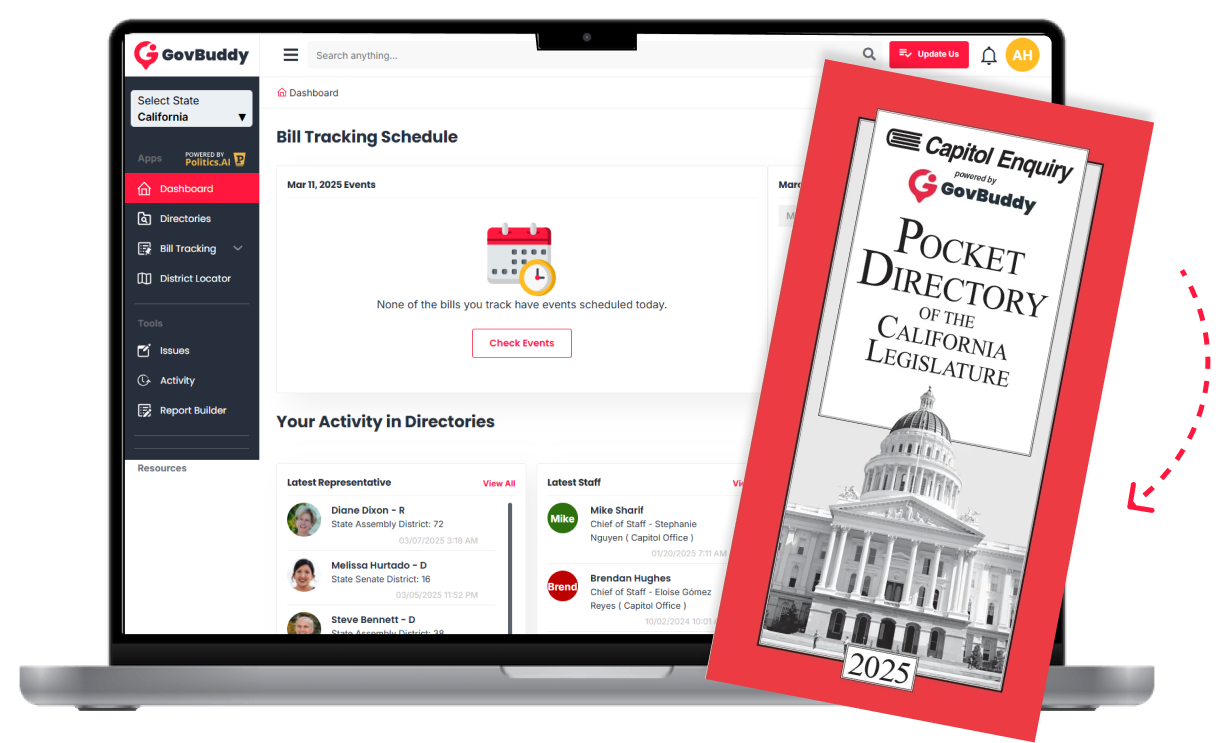
GovBuddy, for instance, combines legislative tracking with an AI chat layer that lets you actually interrogate what you’re monitoring. Not just “here’s a list of bills,” but “what does this mean, how does it compare, what am I missing?” That’s the kind of practical shift that changes how a team operates day to day.
The technology is catching up to how government affairs professionals actually think. The teams using AI in government relations well aren’t working less, they’re finally working on the right things