By the GovBuddy team · Last reviewed May 18, 2026
Quick Answer
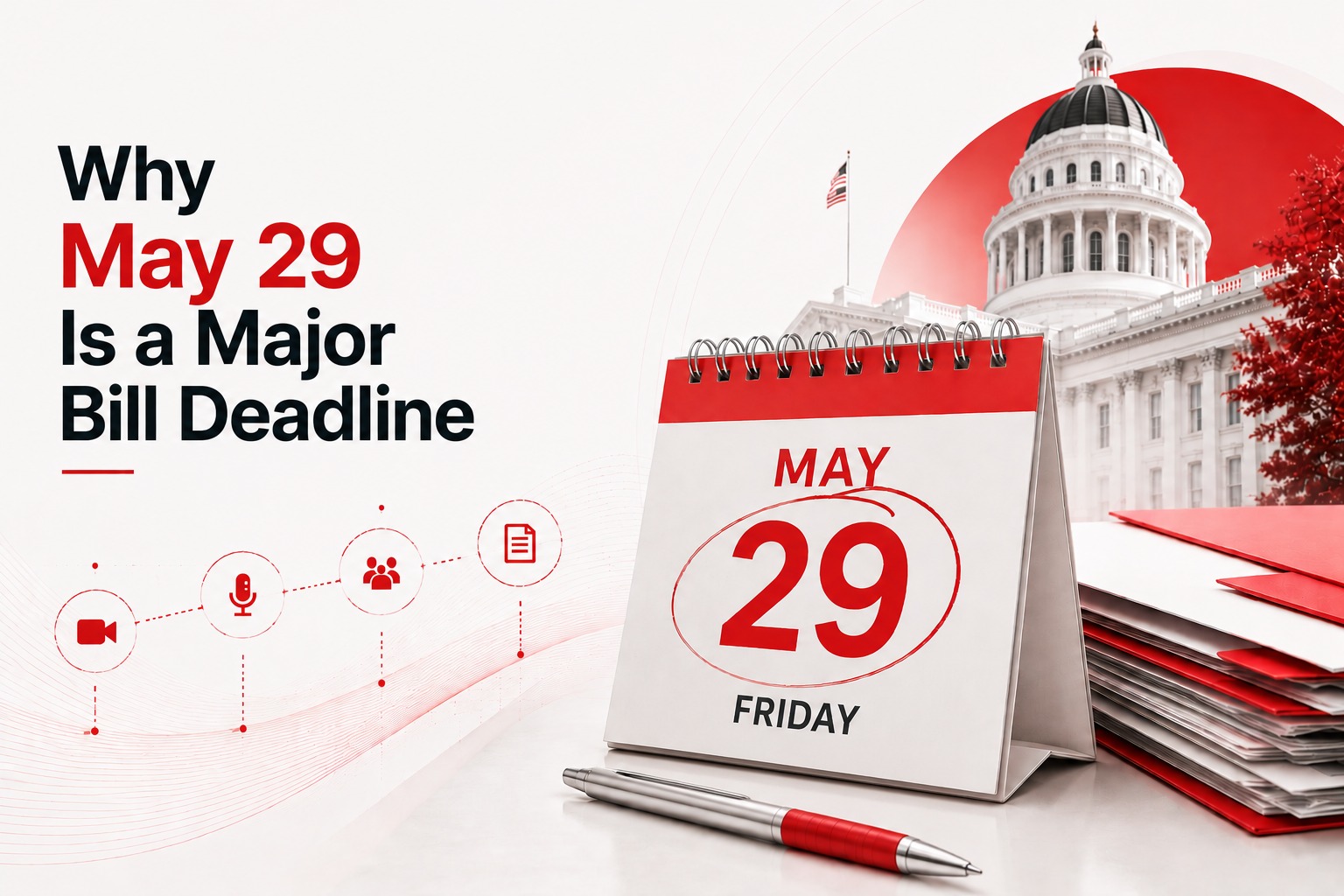
May 29, 2026 is the last day for each house of the California Legislature to pass bills introduced in that house. Per Joint Rule 61(b)(11) and the official Senate Legislative Deadlines calendar, any bill that does not clear its house of origin by close of business on May 29 is held for the year. The four days leading up to it , May 26 through 29 , are floor session only. No committees meet except conference and Rules. This is the second hard cliff of the 2026 session after the May 15 fiscal deadline, and it is the one that decides whether a surviving fiscal bill actually crosses over to the second house.
Table of contents
- Quick reference: the May 2026 California legislative deadlines
- What is the May 29 deadline?
- Why May 29 matters more than May 15 for most bills
- What “floor session only” actually changes about your week
- How a bill dies on May 29 without a recorded vote
- The bills to watch through May 29
- Your 11-day action checklist
- What happens after May 29
Quick reference: the May 2026 California legislative deadlines
| Date | What happens | Rule |
|---|---|---|
| May 1 | Last day for policy committees to report nonfiscal bills to the Floor | J.R. 61(b)(6) |
| May 8 | Last day for policy committees to meet prior to June 1 | J.R. 61(b)(7) |
| May 15 | Last day for fiscal committees to report bills to the Floor (suspense file) | J.R. 61(b)(8)(9) |
| May 25 | Memorial Day | — |
| May 26 – 29 | Floor session only. No committees except conference or Rules. | J.R. 61(b)(10) |
| May 29 | Last day for each house to pass bills introduced in that house | J.R. 61(b)(11) |
| June 1 | Committee meetings may resume | J.R. 61(b)(12) |
Source: Office of the Secretary of the Senate and Office of the Assembly Chief Clerk, 2026 Tentative Legislative Calendar (revised September 29, 2025).
What is the May 29 deadline?
May 29, 2026 is the house of origin deadline for bills introduced in 2026. Joint Rule 61(b)(11) states it plainly: it is the last day for each house to pass bills introduced in that house. The Senate must pass its Senate bills by midnight. The Assembly must pass its Assembly bills by midnight. Anything still sitting on the Floor after May 29 is held, and the carryover rules from Article IV, Section 10(c) take it from there.
This is the second hard cliff of the 2026 session. The first was May 15, when fiscal committees finished their suspense work. May 15 decided which bills got pulled off the suspense file and sent to the Floor. May 29 decides which of those bills the full house is actually willing to vote into existence.
The two deadlines do different work. A bill that survived May 15 is not safe. It has cleared the committee filter and is now exposed to every member of its house, every coalition that opposed it in committee, and every last-minute amendment fight that did not happen in Appropriations.
Why May 29 matters more than May 15 for most bills
May 15 is the deadline most people circle on the calendar because the suspense file is dramatic. The chair calls the file. Bills get pulled or held. The morning produces a clean list of survivors and casualties.
May 29 does not work that way. There is no single hearing. There is no chair calling the file. There are four days of floor session , May 26, 27, 28, and 29, where every bill that made it through fiscal committee has to find its votes one at a time, in order, against the clock.
For a bill that cleared suspense with a thin coalition or a fragile fiscal note, May 29 is the harder test. The author needs a real floor count. Leadership needs to find time on the calendar. The bill has to compete for floor space against every other bill in its house. Bills that get to the back of the line on May 29 itself can run out of clock and die without ever being called.
This is where the math of a session actually gets done. The suspense file decides whether a bill is alive in principle. The May 29 floor deadline decides whether it is alive in fact.
What “floor session only” actually changes about your week
From May 26 through May 29, no policy committee meets. No fiscal committee meets. Per J.R. 61(b)(10), the only committees that can meet at all are conference committees and the Rules committees in each house. Everything else stops.
That changes the geometry of advocacy work for the week.
You cannot get a bill amended in committee. The committee process is closed. Any amendments at this stage are floor amendments, submitted, posted, and voted on as part of the floor record. The window for the quiet committee fix is gone.
Author offices are on the floor, not in their offices. Calls and emails route to chiefs of staff and legislative directors who are themselves working the floor. The pace of returning calls slows. The bench thins. The people you actually need are sitting in their chamber seats, voting.
The Daily File is the document that matters. Each chamber’s Daily File is the running agenda of bills queued for floor action. Reading the Daily File the night before tells you which of your bills are likely to be called the next morning and which have been moved down the order. Bills that keep slipping down the file are the ones in trouble.
The third reading file is where bills go to be voted on. A bill on third reading is one floor vote away from passage. A bill stuck on second reading on May 28 is in real danger of not making it to third reading in time.
The whole week runs on a different cadence than the rest of session. If your workflow is built around committee hearing intelligence, the four days before May 29 are the days when that workflow returns the least value and floor intelligence returns the most.
How a bill dies on May 29 without a recorded vote
The suspense file is famous for killing bills without a recorded substantive vote. May 29 has its own version of the same problem.
A bill that is never called for a floor vote on or before May 29 simply stops. There is no roll call. The Daily File closes, the session adjourns, and the bill stays where it was. Under Article IV, Section 10(c), it cannot be acted on by the house in the rest of the regular session.
That is the quiet kill. The recorded version is a failed floor vote, which is rare on May 29 because authors generally do not call up bills they cannot pass. The common version is a bill that the author pulls back, or that leadership never schedules, because the count is not there.
If you are tracking a bill from a national platform, the signal you will see is the absence of action. The status will simply stop changing. There is no formal “held” notation the way there is for a suspense file bill. The bill is alive on paper until the carryover rules retire it later in the session.
This is why a tracker built for federal coverage misses California’s procedural cliffs. The substantive votes are public. The decisions about which substantive votes to hold are not.
The bills to watch through May 29
This list is not exhaustive, by the time you read this, your own tracker should be telling you which of your priority bills are queued on the Floor and which are still working through their last amendments. What follows is a sample of high-attention bills that surfaced through the 2026 session and that government affairs professionals across multiple verticals are watching through May 29.
Housing and land use
- SB 79 — transit-oriented upzoning across eight counties. A 2025 carryover that has reshaped the housing coalition map.
- AB 712 — limits on indemnification clauses cities impose on housing developers under state housing law.
AI and technology
- SB 53 — frontier AI safety framework requirements for companies above the $500M revenue threshold.
- AB 33 — the autonomous vehicle bill backed by the Teamsters; status to watch closely through the final floor days.
Employment and labor
- SB 617 — expanded WARN Act notice requirements, including local workforce board coordination.
- SB 642 — Equal Pay Act amendments extending the statute of limitations to three years with a six-year recovery window (effective January 1, 2026).
Health and consumer protection
Position letters submitted through the Legislature’s portal continue to be hidden from public view, per the March 2026 CalMatters investigation. For coalition mapping on health and consumer bills, the spoken testimony record from policy and fiscal committees remains the primary source, see our earlier coverage of how to track lobbyist testimony at California committee hearings.
The bills above are illustrative. The actual list you need is the list of bills your clients or your organization is paying you to track, sorted by floor position as of the morning of May 26.
Your 11-day action checklist
This week (May 18 – 22)
- Pull your tracker. For every bill on it, confirm: has it cleared the May 15 fiscal deadline? If yes, where does it sit in the Daily File?
- Identify the floor managers in each house for your priority bills. The floor manager — not the bill author — is the person who will be working the count on May 28 and 29.
- Confirm the author’s office knows your position. If you registered support or opposition in committee, the Floor staff may or may not have that on their working list.
- Re-read the bills that were amended on suspense. The version the Floor will see may not match the version you analyzed in April.
The floor week (May 26 – 29)
- Read the Daily File the night before each floor session day. Bills moving up the file are likely to be called. Bills sliding down are at risk.
- Watch for floor amendments posted late. A May 27 floor amendment can be the substantive change that gets a wavering vote across.
- Track which committee chairs are speaking on the Floor on behalf of bills they shepherded. A chair speaking for a bill is a strong public signal.
- For bills on the bubble, follow the third reading file specifically. A bill stuck on second reading on May 28 is in trouble.
May 29 itself
- Be ready for late-night floor sessions. The chamber typically does not stop until business is finished.
- Have a list of bills you expect to pass, a list of bills you expect to die, and a list of bills you are uncertain about. Compare against the actual outcome the next morning. The gap between expectation and outcome is the lesson the session is teaching you.
What happens after May 29
A bill that passes its house of origin on or before May 29 crosses over to the second house. The second-house policy committee process restarts on June 1, when committee meetings may resume per J.R. 61(b)(12). The second-house fiscal deadline runs to August 14, with the second-house suspense file finishing by that date. The final house-of-origin deadline for the entire session is August 31, the last day for each house to pass bills under Article IV, Section 10(c) and J.R. 61(b)(17).
A bill that does not pass its house of origin by May 29 is held under the carryover rules. It is not technically dead, it can be carried into the 2027 session if the biennium permits, but for the purposes of the 2026 calendar, it is finished. Authors weighing whether to push a bill through May 29 or hold it for next session typically have that conversation in the last week of May. The decision is rarely public until the floor schedule reflects it.
For organizations running multi-state programs, the second-house process in California overlaps with New York’s June close and the start of Ohio’s interim recess. The contact map for the second house is a different working list than the first house, and the committee staff who hear bills on the second-house side are not the same staff you worked in the first.
Track May 29 with GovBuddy Engage
GovBuddy Engage monitors the Daily File, floor amendments, and lobbyist positions on every California bill in real time, so you walk into May 29 knowing which of your bills are queued, which are sliding, and which are about to die without a recorded vote.
The teams that read May 29 ahead of the room are the ones running on Engage. See it for your bills before the floor week starts.
Frequently asked questions
What is the California May 29 deadline?
May 29, 2026 is the last day for each house of the California Legislature to pass bills introduced in that house, under Joint Rule 61(b)(11) and Article IV, Section 10(c) of the California Constitution. Bills that do not pass their house of origin by May 29 are held under the carryover rules for the rest of the regular session.
What happens between May 26 and May 29 in the California Legislature?
Per Joint Rule 61(b)(10), May 26 through May 29 is floor session only. No committees meet except conference and Rules committees. All bill action during this window happens on the Floor of each house.
How is the May 29 deadline different from the May 15 deadline?
May 15 is the last day for fiscal committees to report bills to the Floor, the suspense file deadline. May 29 is the last day for each house to actually pass bills on the Floor. A bill that survives the May 15 fiscal committee process can still die on May 29 if it does not get a floor vote in time.
Can a bill that misses May 29 be revived?
A bill that misses the May 29 house of origin deadline is held for the rest of the regular 2026 session. Depending on the biennium rules, it may be eligible to carry over to the next session. Authors can also use the gut-and-amend process to substitute new language into a shell bill that already passed its house of origin, but only if a vehicle is available.
What is the Daily File in California?
The Daily File is the running agenda for each chamber, listing the bills queued for floor action. During the May 26 – 29 floor-only window, the Daily File is the document that governs which bills are called for a vote and in what order. The third reading file is the sub-list of bills one floor vote away from passage.
When does the second-house process start after May 29?
Per Joint Rule 61(b)(12), committee meetings may resume on June 1. Bills that crossed over to the second house begin moving through second-house policy committees from that date. The second-house fiscal deadline runs to August 14, with the second-house suspense file finishing by that date, and the final session-wide house of origin deadline is August 31.
Sources
- 2026 Tentative Legislative Calendar — Office of the Secretary of the Senate and Office of the Assembly Chief Clerk (revised September 29, 2025)
- California Constitution, Article IV, Section 10(c) — house of origin deadline
- California Senate Legislative Deadlines page
- California State Assembly Daily File
- Senate Appropriations Committee FAQs
- LegInfo — California Legislative Information