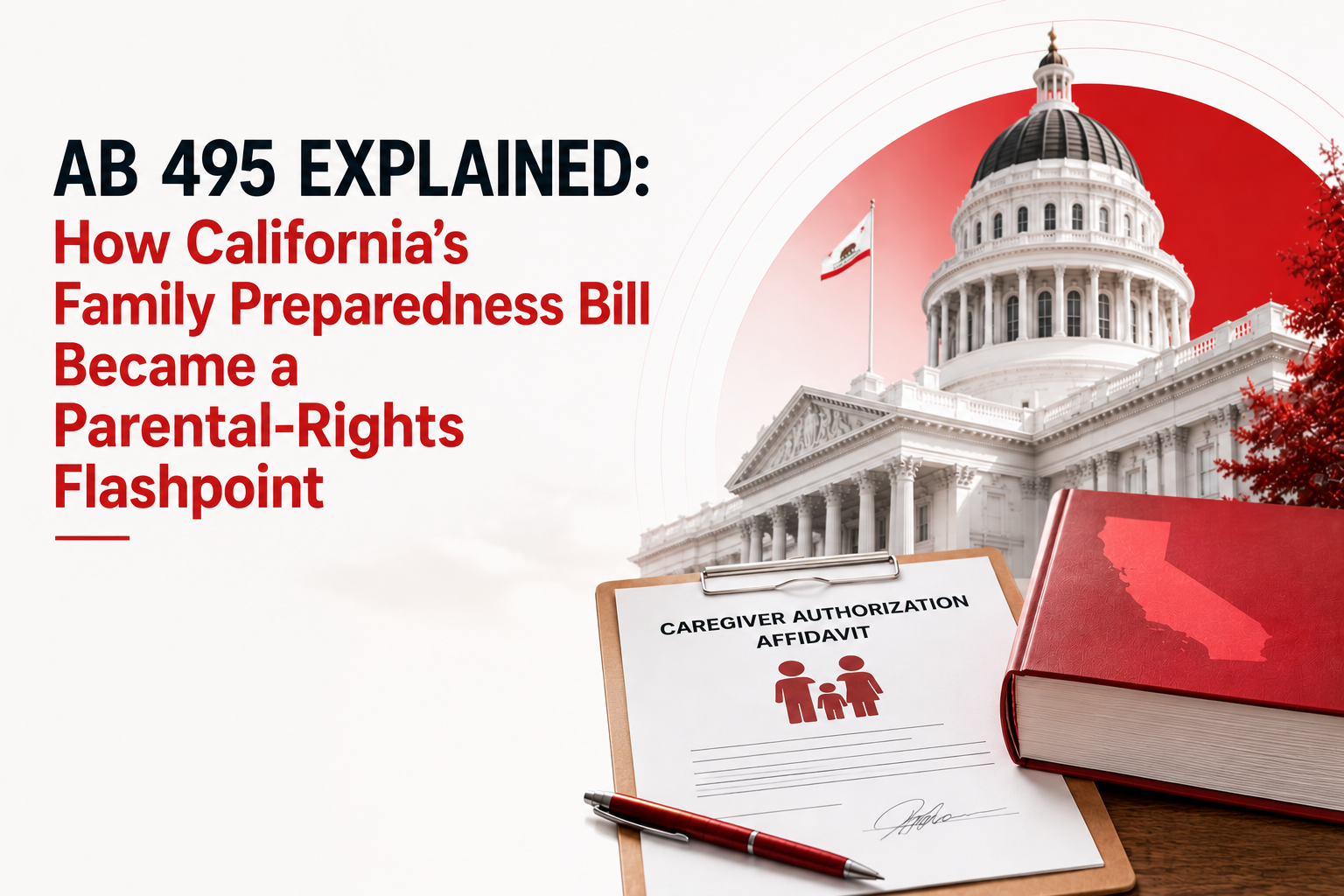
AB 495 Explained: How California’s Family Preparedness Bill Became a Parental-Rights Flashpoint
By the GovBuddy team · Last reviewed May 22, 2026
Quick Answer
AB 495, the Family Preparedness Plan Act of 2025, was signed by Governor Gavin Newsom on October 12, 2025 and chaptered as Chapter 664. Authored by Assemblymember Celeste Rodriguez, it updates California’s caregiver authorization affidavit rules, expands joint guardianship for temporary parental unavailability, adds school information requirements, and extends immigration-enforcement protections to licensed childcare facilities and state preschool programs. Most provisions took effect January 1, 2026, with Attorney General model policies due April 1, 2026 and preschool adoption required by July 1, 2026. The law passed after a months-long public fight in which the legal mechanism and the public narrative became two different fights.
Table of contents
- The fear that started the bill
- Why existing law was not enough
- The phrase that changed the debate
- How opposition reframed the bill
- How supporters defended it
- The final debate: text versus misinformation
- What AB 495 actually does now
- How AB 495 passed
- What AB 495 teaches about bill tracking
The fear that started the bill
A parent is detained. A child is at school or daycare. Nobody knows who has legal authority to pick the child up, keep them enrolled, or authorize medical care. That scenario, repeated in nearly every committee hearing, is where AB 495 began.
Assemblymember Celeste Rodriguez introduced the bill on February 10, 2025. In her opening committee testimony she cited California’s 10.6 million immigrants and at least 1 million children with one immigrant parent, and connected those numbers to the trauma of sudden family separation. In Assembly Human Services she described families fearing ICE “showing up and tearing their families apart,” referenced her own father’s childhood experience of seeing his caregiver detained, and pointed to a recent case of a father detained in front of his children on the way to school.
The bill’s emotional center was not abstract immigration policy. It was the school pickup problem.
Why existing law was not enough
The sponsors gave the bill its legal argument in Assembly Judiciary. Their case was not that California had no tools. It was that the existing tools failed in two opposite ways.
Sharon Cartagena of Public Counsel testified that her organization’s guardianship team assists more than 80% of litigants navigating probate guardianship in Los Angeles County. She described a mother detained by ICE who had arranged for a family friend to care for her child. When the mother returned four months later, the friend refused to return the child, and the court would not quickly dissolve the temporary guardianship. Cartagena argued that California lacked nuanced temporary-care tools, that traditional guardianship could suspend a parent’s rights even when there were no concerns about fitness, and that AB 495 would create a middle ground letting a parent share custody with a non-parent while staying involved.
Kristin Power of the Alliance for Children’s Rights gave the opposite half of the problem. Caregivers who had completed a caregiver authorization affidavit, she testified, still faced resistance from schools and medical providers who did not consistently honor the document. She described a caregiver seeking medical care for her nephew, Gabriel, whose provider refused the affidavit and demanded parental authorization or proof of guardianship. The care was delayed until attorneys intervened.
That was the policy problem the bill was trying to solve. Informal affidavits could be ignored by institutions. Formal guardianships could be too heavy and too hard to unwind. AB 495’s authors argued California needed something in between.
The phrase that changed the debate
The earliest committee versions of AB 495 included language allowing the caregiver authorization affidavit to be used by “nonrelative extended family members,” a category that explicitly included close family friends and godparents. That phrase became the bill’s attack surface.
By the time the Assembly concurred in the Senate amendments, the bill had changed. The final concurrence analysis states that Senate amendments removed the caregiver-affidavit changes related to nonrelative family members and clarified daycare, childcare, and joint guardianship provisions.
If you only read the first version, you miss the compromise. If you only read the final version, you miss why the fight exploded.
This is the gap that defines AB 495 as a case study. The language that powered the opposition campaign was not the language that survived intact into law. But the campaign continued past the amendment, because most of the public was responding to a version of the bill that no longer existed.
How opposition reframed the bill
The Senate Appropriations hearing was the turning point in public visibility. The author waived presentation, and the hearing moved straight into public testimony. There were no support witnesses at first. The fiscal hearing became an opposition platform.
Greg Burt of the California Family Council argued that the caregiver authorization affidavit was designed to operate without parental consent because it required neither a parent signature nor a court seal. He argued the bill would let an unrelated adult claiming a mentoring relationship pick up a child from school and make medical decisions, and warned of constitutional and litigation risks. By the Senate floor, Senator Kelly Seyarto argued that existing law already gave parents the tools to designate caregivers, and that AB 495 imposed costly mandates on schools, childcare providers, and courts without adding parent signature, court seal, or notarization. Senator Suzette Martinez Valladares, drawing on her experience as a parent and former childcare provider, argued that childcare providers must know exactly who they are releasing children to, and that a penalty for perjury imposed after the fact does not protect a child in the moment.
These were not abstract arguments. The opposition’s strongest framing was a question about speed versus safeguards: supporters wanted families to be able to act quickly when a parent disappeared; critics argued that fast paperwork could create real-time child-safety and institutional liability risk.
That framing was harder to dismiss than the inaccurate claims that traveled alongside it, and it shaped every floor debate that followed.
How supporters defended it
By the Senate floor, the bill’s defenders had stopped explaining what AB 495 did and started defending what it did not do.
Senator Susan Rubio compared the affidavit process to a parent choosing someone trusted in advance, similar to how individuals use powers of attorney when they cannot act for themselves. The process, she argued, was authorized and legal, not strangers picking up children. Senator Scott Wiener pointed out that California’s caregiver framework dated back to the 1990s and argued that when parents and children are separated through incarceration, deportation, or another reason, parents should be able to plan in advance so children are not routed into foster care as a first response.
On the Assembly concurrence floor, Assemblymember Sade Elhawary made the case in human terms. Every parent’s worst fear, she said, is being separated from a child, whether through illness, incarceration, military deployment, or immigration detention. AB 495, she argued, keeps children with trusted loved ones rather than strangers or the system. She emphasized that the caregiver still has to provide identifying information and sign under penalty of perjury, and that the bill applies when the child is already living with the caregiver.
The supporters’ core move was a reframe: AB 495 was not about replacing parents. It was about giving parents a legally recognized way to choose who steps in before the state has to.
The final debate: text versus misinformation
By the Assembly concurrence vote on September 11, 2025, the floor debate was no longer only about bill mechanics. It had become a debate about the public campaign around the bill itself.
Rodriguez told the chamber that opponents had harassed her staff, made racist statements, and threatened her life and her children’s lives. She asked opponents to read the bill instead of spreading misinformation, then asked colleagues to create family preparedness plans of their own. Assemblymember Patrick Ahrens said there was significant misinformation about the bill and argued that the attacks had escalated into threats of violence. Assemblymember Carl DeMaio, opposing the bill, argued that the original version of AB 495 deserved criticism because it had allowed a nonrelative extended family member to claim a mentoring relationship with a minor. When Rodriguez asked whether members could misrepresent a bill during debate, the Speaker responded that members are encouraged to refute information they believe is inaccurate.
AB 495 passed, but the opposition changed the story. By the end, supporters were not only explaining what the bill did; they were defending what it did not do.
What AB 495 actually does now
The final law, signed October 12, 2025 and chaptered as Chapter 664, does the following:
- Updates the caregiver authorization affidavit. The statutory form is revised. The Senate amendments removed the earlier expansion to nonrelative family members.
- Revises the definition of “relative” for caregiver purposes and clarifies school-related medical care that a caregiver may consent to.
- Requires schools to share family-safety information. Local educational agencies must give families information aligned with California Attorney General guidance, including family safety plans, caregiver authorization affidavits, and the importance of keeping emergency contacts current.
- Extends immigration-enforcement protections to licensed child daycare facilities and license-exempt California state preschool programs. These facilities generally may not collect immigration-status information from children or families unless required by law or needed to administer a supported program.
- Requires reporting of immigration-enforcement-related requests for information or facility access to the State Department of Social Services and the Attorney General, or in some preschool cases to the State Department of Education and Attorney General.
- Requires Attorney General model policies by April 1, 2026 limiting assistance with immigration enforcement at those facilities. State preschool programs must adopt those policies, or equivalent policies, by July 1, 2026.
- Expands joint guardianship for temporary parental unavailability. A court may, at its discretion, appoint a custodial parent and a person the parent nominates as joint guardians when the parent will be temporarily unavailable because of a serious medical condition, disability, military service, incarceration, or immigration-related administrative action.
- Makes joint guardianship records confidential and prohibits disclosure to immigration enforcement without a court order based on compelling necessity unrelated to immigration enforcement.
The court is still the gatekeeper. AB 495 does not allow anyone to become a legal guardian without a court order.
How AB 495 passed
The bill cleared every committee and both floors before reaching the Governor. The vote that locked in the final language was the Assembly concurrence vote on September 11, 2025, after the Senate amendments narrowed the bill. Along the way, AB 495 was placed on the Senate Appropriations suspense file on August 18, 2025 before being voted out “do pass as amended” on August 29. That was the procedural step where the bill’s final shape was actually decided.
| Stage | Vote |
|---|---|
| Assembly Floor (June 3, 2025) | 62–7 |
| Senate Appropriations, “do pass as amended” (August 29, 2025) | 5–2 |
| Senate Floor (September 10, 2025) | 29–10 |
| Assembly concurrence in Senate amendments (September 11, 2025) | 60–20 |
The 60–20 concurrence vote was the final lock-in. The 5–2 Senate Appropriations vote on August 29 was the moment that made the final language possible. For the procedural context on how California’s mid-session deadlines work, see our companion piece on why May 29 is a major California bill deadline.
What AB 495 teaches about bill tracking
AB 495 is a case study in why following a bill’s title is not enough. The real story lived in committee testimony, amendment language, opposition mobilization, floor debate, fiscal analysis, and the final concurrence analysis written by the committee staff who shape state policy in California, New York, and Ohio. By the time most people searched “AB 495,” the bill’s language had already changed and the political fight had already hardened around an earlier version.
The lesson is not partisan. It is operational. Whichever side of this bill you were on, the version that became law was different from the version that became famous, and the difference was visible in the amendment trail months before the Governor’s signing statement.
Track bills before they become headlines
AB 495 did not become controversial overnight. The warning signs were visible in committee testimony, amendment language, opposition letters, fiscal analysis, floor debate, and concurrence votes. GovBuddy Engage helps legislative teams see those signals early, before the public narrative hardens and before the language is locked.
Frequently asked questions
What is AB 495?
AB 495 is the Family Preparedness Plan Act of 2025, a California statute that updates caregiver authorization affidavit rules, expands joint guardianship for temporary parental unavailability, adds school information requirements, and extends immigration-enforcement protections to licensed childcare facilities and state preschool programs. It was authored by Assemblymember Celeste Rodriguez.
Is AB 495 law?
Yes. Governor Gavin Newsom signed AB 495 on October 12, 2025 and it was chaptered the same day as Chapter 664, Statutes of 2025. Most provisions took effect January 1, 2026.
Why was AB 495 controversial?
Early versions of the bill expanded the caregiver authorization affidavit to “nonrelative extended family members.” Critics argued the expanded language created caregiver authority without sufficient verification, raising parental-rights and child-safety concerns. Supporters argued the bill preserved parental choice and prevented children from being routed into foster care after sudden separation. Senate amendments removed the caregiver-affidavit changes related to nonrelative family members before the bill became law.
Did AB 495 allow nonrelatives to become caregivers?
The earlier versions contained language that opponents argued could enable that. The final concurrence analysis confirms that Senate amendments removed the caregiver-affidavit changes related to nonrelative family members. The chaptered law does not contain that expansion.
What changed in the Senate amendments?
The Senate amendments removed caregiver-affidavit changes related to nonrelative family members and clarified daycare, childcare, and joint guardianship provisions. The Assembly concurred in those Senate amendments on September 11, 2025, locking in the version Governor Newsom signed.
Does AB 495 remove parental rights?
The Governor’s signing statement said AB 495 does not change legal custody or guardianship without a court decision and does not make someone a child’s caregiver, legal custodian, guardian, or parent without a court order. Critics argued the bill’s practical effect could weaken parental authority; supporters argued it preserved parental choice while giving families more planning tools.
Does AB 495 require a court order for guardianship?
Yes. The joint guardianship provision in AB 495 requires a court, exercising its discretion, to appoint the custodial parent and a nominated person as joint guardians. The court remains the gatekeeper. AB 495 does not allow guardianship to be established without a court order.
What does AB 495 mean for schools and childcare providers?
Local educational agencies must provide families with information aligned with California Attorney General guidance, including family safety plans, caregiver authorization affidavits, and emergency contact updates. Licensed child daycare facilities and state preschool programs generally may not collect immigration-status information from children or families unless required by law, and certain immigration-enforcement-related requests must be reported to state agencies.
When do AB 495 implementation deadlines apply?
Most of the law took effect January 1, 2026. The Attorney General must publish model policies for childcare facilities and state preschool programs by April 1, 2026. California state preschool programs must adopt those policies, or equivalent policies, by July 1, 2026.
What does AB 495 teach about California bill tracking?
AB 495 shows that following a bill’s title is not enough to understand what it does or why it matters. The version that became law was substantively different from the version that became publicly controversial. The amendment trail, committee testimony, and concurrence analysis told a more accurate story than the headlines did, and they were available months earlier.
Sources
- AB 495, California Legislative Information, bill text, history, and votes
- Chapter 664, Statutes of 2025, chaptered version
- Assembly Concurrence in Senate Amendments, AB 495 analysis, September 11, 2025
- Senate Floor Analysis, AB 495, sponsors and sources
- Governor’s signing statement, Office of Governor Gavin Newsom, October 12, 2025
- San Francisco Chronicle reporting on AB 495 and the historical context of California’s caregiver authorization affidavit
- ABC7 / KGO reporting on Capitol opposition rallies, August 2025
- KCRA reporting on post-signing reaction and opposition organizing