By the GovBuddy team · Last reviewed June 23, 2026
Quick Answer
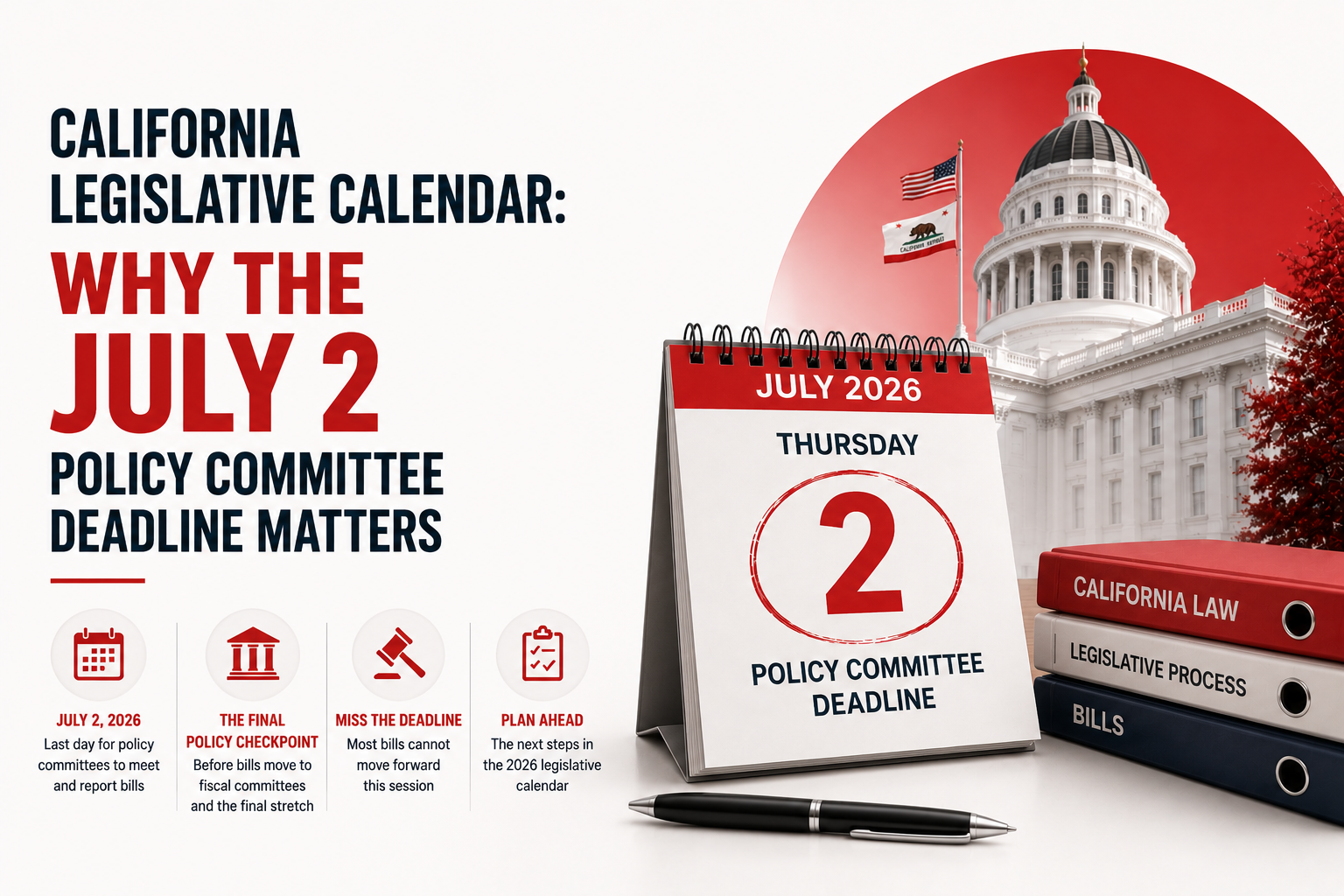
July 2, 2026 is the final ordinary deadline for California policy committees to meet and report bills during the 2025–26 Regular Session, under Joint Rule 61(b)(13). It principally affects ordinary bills referred to second-house policy committees after passing their house of origin. A bill that is not acted upon by its policy committee by July 2 generally cannot continue during the 2026 session under normal procedures, although Joint Rule 61 provides limited exceptions and a formal suspension process. When a committee timely votes to report a bill with Legislative Counsel amendments still being prepared, the report may be received within seven calendar days after the deadline. Summer recess begins after adjournment on July 2, provided the Budget Bill has passed, and the Legislature reconvenes August 3. Because 2026 is the final year of the biennium, unsuccessful bills do not carry into 2027 and ordinarily must be reintroduced in the next regular session.
Table of contents
- What July 2 actually means
- Where July 2 sits in the 2026 calendar
- What “last day to meet and report bills” does to a bill
- Which bills are at risk between now and July 2
- What second-house policy committee work looks like in the final week
- What happens after July 2: Summer Recess and the August stretch
- What this means for advocacy and government affairs teams
What July 2 actually means
Joint Rule 61(b)(13) sets July 2 as the last day for policy committees to meet and report bills. The rule is short. The consequences are not.
A California bill that originates in one chamber has to clear two sets of policy committees: the ones in its house of origin (subject to the April 24 fiscal-bill and May 1 nonfiscal deadlines), and the ones in the second house after the bill crosses over post-May 29. July 2 is the deadline for that second-house policy review. After July 2, second-house policy committees do not ordinarily meet again this session. A bill that fails to advance before the deadline generally cannot proceed further during the 2025–26 Regular Session. Because 2026 is the final year of the biennium, the proposal would ordinarily need to be introduced again as a new bill in the 2027–28 session.
That makes July 2 a quiet but decisive checkpoint. May 29 is famous because every bill in the Legislature is fighting for floor time at once. August 31 is famous because it is the final passage deadline. July 2 sits in between, and it is the deadline most of the public never hears about. For the bills that crossed over on May 29 and are now working their second-house policy committees, July 2 is the last ordinary opportunity to clear policy review and reach the fiscal committees that follow in August.
Where July 2 sits in the 2026 calendar
The 2026 session has a rhythm. Each hard deadline filters out a cohort of bills and sends the survivors to the next stage. July 2 is one of those filters.
| Date | Deadline | Rule |
|---|---|---|
| May 1 | Policy committees report nonfiscal bills to the Floor | J.R. 61(b)(6) |
| May 8 | Policy committees meet prior to June 1 | J.R. 61(b)(7) |
| May 15 | Fiscal committees report bills to the Floor (first-house suspense) | J.R. 61(b)(8)(9) |
| May 26 – 29 | Floor session only in first house | J.R. 61(b)(10) |
| May 29 | Each house passes bills introduced in that house | J.R. 61(b)(11) |
| June 1 | Committee meetings may resume in the second house | J.R. 61(b)(12) |
| June 15 | Budget Bill must be passed | Cal. Const. Art. IV, § 12(c)(3) |
| June 25 | Last day for a legislative measure to qualify for the November ballot | Elec. Code § 9040 |
| July 2 | Policy committees meet and report bills | J.R. 61(b)(13) |
| July 2 | Summer Recess begins at adjournment (Budget Bill must be passed) | J.R. 51(b)(2) |
| August 3 | Legislature reconvenes from Summer Recess | J.R. 51(b)(2) |
| August 14 | Fiscal committees meet and report bills to the Floor | J.R. 61(b)(14) |
| August 17 – 31 | Floor session only | J.R. 61(b)(15) |
| August 21 | Last day to amend bills on the Floor | J.R. 61(b)(16) |
| August 31 | Each house passes bills | Cal. Const. Art. IV, § 10(c); J.R. 61(b)(17) |
Source: 2026 Tentative Legislative Calendar, Office of the Secretary of the Senate and Office of the Assembly Chief Clerk.
For the May 29 first-house deadline that feeds into the second-house process, see our companion piece on why May 29 is a major California bill deadline.
What “last day to meet and report bills” does to a bill
The rule’s language matters. “Meet and report” means a policy committee acts on the bill on or before July 2. Reporting is the formal action that moves a bill out of committee with the committee’s recommendation. Ordinarily, the committee must act on the bill by July 2. If it timely votes to report the bill with amendments that Legislative Counsel has not yet prepared, the formal report and amendments may be received within seven calendar days after the deadline under Joint Rule 61(c). The decisive event is therefore usually committee action by July 2, not necessarily completion of every administrative reporting step that day.
A bill that the committee does not act on by the deadline, or that the committee declines to report, generally cannot continue during the 2025–26 Regular Session. Because 2026 is the final year of the biennium, the proposal would ordinarily need to be introduced again as a new bill in the 2027–28 session.
There are three practical outcomes for any second-house policy committee bill in the final week before July 2:
Cleared. The committee hears the bill, votes do-pass or do-pass-as-amended, and reports it to the next stage (usually the fiscal committee, sometimes directly to the Floor for nonfiscal bills).
Held. The committee declines to act on the bill or votes it down. The bill stays in committee. Without a procedural revival or rules suspension under Joint Rule 61, it does not advance in the 2025–26 session.
Pulled. The author withdraws the bill from committee consideration. Authors do this when they expect a fail vote that would attach to the bill’s record, or when they need more time to negotiate amendments before the next session.
The practical effect for tracking purposes is the same in all three cases: after July 2, the policy committee stage is closed. The bills that are alive in the second half of session are the ones that cleared.
Which bills are at risk between now and July 2
The bills at risk are second-house policy bills. These fall into a few recognizable patterns:
- Bills that crossed over after a contested first-house floor vote in late May. These often arrive in the second house already weakened, with negotiated amendments to pick up the votes they needed. The second-house policy committee may want further amendments. If the timeline is short and the negotiations are complex, July 2 can arrive before agreement.
- Bills referred to multiple second-house policy committees. A bill that touches more than one policy area gets referred to each relevant committee. Each must hear and report by July 2. Multi-referral bills with controversial provisions are the most exposed.
- Bills that the second-house chair declined to set early. Chairs control the agenda. A bill the chair sets in the final week before July 2 has very little room to absorb amendments or reschedule if the hearing runs long.
- Bills with active opposition that emerged after the first-house vote. A coalition that did not engage in the first-house policy committees but mobilized after the May 29 floor vote can use the second-house policy stage to force amendments or to push the chair to hold the bill.
For organizations tracking specific bills, the practical question is whether the bill has a confirmed July hearing date and whether the working version of the bill matches what the second-house chair will accept. If both answers are not yes by the final week of June, the bill is in the at-risk category.
Reach the right offices with GovBuddy Connect
The bills clearing or stalling in second-house policy committees between now and July 2 are not decided by floor votes. Outcomes are shaped by committee chairs, consultants, author staff, stakeholders, and ultimately the committee members who vote on the bill. GovBuddy Connect is the human-verified legislative directory for California, New York, and Ohio: legislators, committee staff, consultants, and lobbyists, kept current by the same Sacramento team that has run the directory since 1973. When the final policy-committee week comes down to which committee consultant returns your call, Connect is how you find them.
What second-house policy committee work looks like in the final week
The final week before July 2 has a particular shape. Committee agendas tend to grow longer than at most other points in the session, and chairs and lead consultants typically spend more time on amendment negotiation than on testimony as the deadline approaches.
A few patterns are worth recognizing if you are tracking bills through this window:
Long agendas mean shorter testimony. When a committee is hearing thirty or forty bills in a single day, the time allocated to public testimony shrinks. Support and opposition speakers are often limited to a name and a position, with full testimony deferred to printed letters. Coalition speakers may not get called at all.
Amendments arrive late and matter more. A bill that was clean coming out of the first house may take substantial amendments in the second-house policy committee. Those amendments are often drafted in the 24 to 48 hours before the hearing. The version of a bill that gets voted on is not always the version that was posted earlier in the week.
Chairs become more selective. A chair who has been letting bills through earlier in the year may start holding bills in the final week to manage the agenda or to preserve leverage. This is rarely public. It shows up as a bill being moved off the calendar or as a deferred vote.
Committee consultants do the negotiating. The chief of staff for a bill author and the lead consultant for the committee are the two people whose conversation determines whether amendments get accepted. These are the people whose calendars matter in the final week.
For tracking, useful indicators include the published committee agendas, the order of bills on each agenda, and the late-week amendment postings. Practitioners often watch for bills that get moved to later positions on an agenda or deferred between hearings as a signal that negotiations may not be complete.
What happens after July 2: Summer Recess and the August stretch
Summer Recess begins at adjournment on July 2, provided the Budget Bill has been passed by the June 15 constitutional deadline. The Legislature reconvenes on August 3. During summer recess, regular floor sessions and committee action on bills pause. Legislative staff continue working on amendments, fiscal analyses, and stakeholder negotiation, and committees may hold properly noticed informational or subject-matter hearings, but they cannot act on bills during the joint recess. The Legislature can also be recalled from recess under Joint Rule 52.
The August stretch is short and dense. Fiscal committees have until August 14 to meet and report bills, which compresses the second-house suspense work into the early part of the month. Floor session then takes over from August 17 through August 31. The final amendments deadline is August 21. The final passage deadline is August 31. By the end of August, every bill that has not passed is held for the year.
For organizations planning their summer, the key calendar facts are these: the policy-committee work is done after July 2. The fiscal work happens August 3 through August 14. The floor work happens August 17 through August 31. The work that has to happen in July is mostly back-channel: amendment negotiation, coalition coordination, and preparing for August’s fiscal committees.
What this means for advocacy and government affairs teams
July 2 is the final ordinary opportunity for substantive policy review in a policy committee. Negotiations and amendments may continue during fiscal review and on the floor, subject to the later August deadlines, but the substantive policy-committee stage is closed after July 2.
For bills you support. Confirm the second-house policy committee hearing date. If the hearing is scheduled in the final week, confirm with the author’s office whether the committee chair appears to have the votes. If amendments are still being negotiated, having specific language in front of the lead consultant well before the hearing week begins is generally more useful than late filings, and coalitions that appear at the hearing in person can still affect chair calculations.
For bills you oppose. The final week before July 2 is a common point at which bills are held or moved off the calendar, since chairs are working to manage their final agendas. Coordinated opposition that reaches the chair and the lead consultant in the days before the hearing can affect whether a bill is heard as scheduled. Public testimony time is often limited; written opposition and direct outreach to the committee and the author’s office are typically more useful.
For bills you track but do not have a position on. The most useful product of the July 2 deadline is the list of bills that cleared. The cohort of bills that survives into the August fiscal stretch is the cohort that will define what gets to the Governor’s desk this year. Pulling that list in the first week of July is a high-value tracking exercise.
Frequently asked questions
What is the California policy committee deadline for 2026?
July 2, 2026 is the final ordinary deadline for California policy committees to meet and report bills during the 2025–26 Regular Session, under Joint Rule 61(b)(13). It principally affects ordinary bills referred to second-house policy committees after passing their house of origin. Joint Rule 61 contains limited exceptions, including a seven-day window under Rule 61(c) when Legislative Counsel amendments are still being prepared, and the rule may be suspended for a particular bill through the required Rules Committee and floor approvals.
What happens to a bill that misses the July 2 policy committee deadline?
A bill held in second-house policy committee on or before July 2 generally cannot continue during the 2025–26 Regular Session. Joint Rule 61 provides limited exceptions, including a seven-day window under Rule 61(c) when Legislative Counsel amendments are still being prepared, and the rule may be suspended for a particular bill through the required Rules Committee and floor approvals. Because 2026 is the final year of the biennium, an unsuccessful bill does not carry into 2027 and ordinarily must be reintroduced as a new bill in the 2027–28 Regular Session.
When does California’s Summer Recess begin in 2026?
Summer Recess begins at adjournment on July 2, 2026, provided the Budget Bill has been passed by the June 15 constitutional deadline. The Legislature reconvenes on August 3, 2026.
What is the difference between the May 8 and July 2 policy committee deadlines?
May 8 (J.R. 61(b)(7)) was the last day for policy committees to meet prior to June 1, which applied to first-house policy work before the May 15 fiscal suspense and the May 29 house-of-origin deadline. July 2 (J.R. 61(b)(13)) is the last day for policy committees to meet and report bills for the rest of the session, which applies to second-house policy work after bills cross over.
What is the next legislative deadline after July 2?
The next hard deadline is August 14, 2026, the last day for fiscal committees to meet and report bills to the Floor (J.R. 61(b)(14)). Floor session takes over from August 17 through August 31 (J.R. 61(b)(15)), with the final passage deadline on August 31 (Art. IV, § 10(c); J.R. 61(b)(17)).
Where can I read California’s official 2026 legislative calendar?
The official calendar is published by the Office of the Secretary of the Senate and the Office of the Assembly Chief Clerk, and is available at senate.ca.gov and assembly.ca.gov. The joint rules that set the deadlines are codified in the Joint Rules of the Senate and Assembly for the 2025–2026 Regular Session.
Sources
- 2026 Tentative Legislative Calendar, Office of the Secretary of the Senate and Office of the Assembly Chief Clerk (revised March 27, 2026)
- California State Assembly 2026 Legislative Calendar, Office of the Assembly Chief Clerk (March 2026 revision)
- Joint Rules of the Senate and Assembly, 2025–2026 Regular Session, Rule 51 and Rule 61
- California Constitution, Article IV, Sections 10 and 12